Tuesday, 21 April 2015

Cagliari, Sardinia

Setting up the storm jib
After a midday departure from Palma, Mallorca we had hoped to sail to Sicily. Initially we had good winds (requiring several reefs) in the main and geona but as the wind continued to increase our pointing angle become less favourable resulting in a reduction in our Velocity Made Good (VMG) to our destination.  In an attempt to improve our pointing (sailing) angle, we decided to furl our genoa and raise the storm sail (jib) which made for a more comfortable boat motion and improved our pointing angle, ie better VMG. This was also a good opportunity to test our procedures for using this bit of safety kit. Surprisingly, Sabbaticus still achieved a maximum speed of 8.2kts in this configuration. 

Porto Teulada anchorage

The wind then lightened considerably, the seas flattened and we ended up motoring for 38hrs - which was very frustrating. With no more wind forecast we motored direct for Sardinia. The entire passage was 311NM which equated to three nights at sea. On arrival in Sardinia we anchored on the south coast in a lovely bay outside Porto Teulada. We felt quite at home with a Chinook flying over several times and hearing the firing from a military rifle range in  the distance. 


Cagliari waterfront

After a peaceful night at anchor we then moved around the coast into Cagliari passing many beautiful white sandy bays on the way to Marina di Sant'Elmo. We thought we would be able to sail this short leg in light winds. However, after motoring East for an hour into wind and then turning the corner to head Nth we thought we would be on a beam reach for the 20 miles to our destination but, you guessed it, round the corner and a 90 deg wind shift - the wind was on the nose again!!!!  Not to worry, we motored into Cagliari on a beautiful day with perfectly calm seas arriving at the Marina in the late afternoon - in daylight (a unique experience for us). 
  
The Castello - ancient fortifications


Sardinia is the second largest island in the Mediterranean Sea (after Sicily) and is a region of Italy. Cagliari is the capital of Sardinia and is the largest city (approx 455,000) on the island. As an ancient city, occupied for 5,000 years, it has a long history that includes the Greeks, Etrusans Romans, Normans, Spanish and French rulers - quite different to our short NZ history. We spent several days ambling through the cobblestone historic quarters, visiting the local markets, viewing the many church's, taking time out for coffee/pastries and enjoying the ambiance of the medieval city.

So many choices ...
As we are learning the simple boat tasks can take a surprisingly amount of time in a foreign country. For example a customs clearance was a three hour process for Leanne. This included the walk to the customs office and a 1 1/2hr visit explaining the NZ bilateral visa agreement with Italy and the need for a passport stamp. After lots of discussions between the Customs Officers' and numerous telephone calls thankfully the Officer finally acquiesced and our passports were stamped - phew! Finding a suitable data plan for the cell phone proved harder for John, requiring three visits to the shop (which was inexplicably closed for no apparent reason) over three days to finally secure a data plan.

We used the time at the marina to complete a treatment on the teak deck against the inevitable mould and algae that occur. We started this job late in the day to ensure the teak stayed damp after the boat wash and between each application of the boracol product. Hopefully in ten days we will see the results and only have to repeat the treatment bi-annually now to maintain the teak. On another afternoon while  Leanne was busy cleaning the topsides, John swam around Sabbaticus's waterline removing the algae that builds up. 

Some photo's below from our Cagliari wanderings.


View from Marina di Sant'Elmo

Friday, 10 April 2015

Altea to Palma, Mallorca

Winch Repairs
This passage to the island of Mallorca, which is one of the four main islands that forms the Balearic Islands (Spanish territory), was a short 150Nm distance but took us three days. Fortunately we did not have to be in Palma until 8 Apr to collect our spares so we had the luxury of time. With light winds for most of the passage it was a busy trip with tacking, sails up, engine off, sails down, engine on ...repeatedly! During one tack in the early hours the port winch failed (in manual mode) under load and then failed to turn. This was the same winch we had replaced the control box and switch in Gibraltar (we were scheduled to uplift a new control box for it in Palma to enable electric operation). With the wind dying we decided to anchor in San Antoni Bay in Ibiza and fix the winch.  While I had a hot shower and prepared breakfast John had stripped the winch and replaced the pawls. While the winch was tested (manual mode) and working we decided to stay the day to wait for the wind and catch up on sleep. 

Entertained by windsurfers at anchor
After a leisurely midday departure and a couple of hours of sailing we then diverted into another Ibiza bay to wait for wind. Setting the alarm clock every 2 hours we finally left at 0530hrs when the wind shift came through. We then had a great sail to Palma in Mallorca. With 2NM to go the wind picked up suddenly to 45kts and caught us by surprise.  It was then a lot of shouting to get all the sails down - thankfully achieved without damage.  We then anchored off Isle de Porassa for several nights before moving around to Palma Nova and anchoring off the beach.There was a small marina close by so we were able to go ashore most days for the obligatory coffee for wifi and leave our dinghy in the marina. While at anchor enjoying the sundowners on deck we were visited by Spanish Customs - thankfully it was a short visit with no search required.

We caught the bus into Palma (approx 530,000 population) which is the capital
Cathedral Sainta Maria
of the Balearic Islands and visited the predominately Gothic Cathedral built in 1601. The medieval old town surrounding the cathedral was the perfect place meander along the narrow streets soaking up the ambience and history. Palma's main industry is tourism and yachting with the marinas/waterfront at the heart of Palma. This is the superyacht capital of the Med and has the infrastructure to support it. For once we were able to purchase all our spares and have a choice of chandleries - luxury after Gibraltar. 


Superyacht mecca
As expected, being the superyacht base the prices matched - we arrived in mid-season and a berth was E75 per night, in high season the cost is E199. There are six marina's in Palma with several thousand yachts in the marina's so plenty of activity and sights to see.   


The installation in progress
The key reason we came to Palma was to install a new hot water cylinder and install a new (the second) control box for the port winch (again). Sam from Oyster customer support in the UK provided excellent logistics support ensuring all parts for the hot water installation arrived in Palma, complete with colour photo's and instructions on how to hook up the various inlets and outlets. Likewise, Lewmar couriered us a replacement winch control box to install.

Job completed
This stopover was a busy time for John completing the installations and testing the systems. I kept busy washing the boat down from all the salt which takes about 4hrs to complete by yourself, doing several loads of washing, defrosting the fridge and freezer, purchasing spares, grocery shopping, updating the inventory, re-locating the extra stores and updating the blog. Our three days in the marina quickly passed and we are now ready for the next passage to either Sardinia to Sicily. This will be a relatively slow passage based on the current wind, but if we don't depart now it will be another 10 day delay.   

Below are some photos from Palma.
Sabbaticus anchored at Palma Nova

Local bakery - we already miss our fresh baguettes!

'Front Door' view from our berth towards Santa Catalina 
'Right Back Door' view
'Left Back Door' view

Sunday, 22 March 2015

Almerimar to Altea, Spain

Marina Office in Almerimar
It was a mixed passage to Altea - 270 NM up the coast. From Almerimar we decided to head off coast to pick up the wind was based on the grib weather files. This turned out to be the wrong decision as we ended up motoring 4 hours to get back to the coast and the wind! However with a trip closer to the coast, about 2 NM off, we had a 'scenic tour' which was good see the coastal tourist developments. 
 
Anchored off the beach at Villajoyosa

During the passage up the coast John had promised fresh fish for dinner to test his new fishing gear. Despite his best efforts the line remained empty for the entire trip. Though we did enjoy seeing the dolphins and turtles who seemed to be sunning themselves.  After sailing in light winds and enjoying being dressed in shorts and teeshirts we decided to anchor for a night in the hope the wind would increase. After 192 NM we arrived in the middle of the night and anchored just off the port at Torrevieja.  After a rolly night (=uncomfortable) at anchorage we were keen to leave and sailed another 63NM, in light airs again, to anchor at Villajoyosa. This was a picturesque anchorage with bright coloured apartments along the expansive waterfront. 
 

Benidorm coast
With very light winds forecasted we headed out to motor for three hours to round the next cape passing Benidorm which reminded of the Gold Coast in Australia.  We then anchored at Mascarat Cove adjacent to Greenwich Marina saving E70 per night. The plan was to use the RIB and go into a cafe for wifi/fresh bread. After getting the RIB off the boat and starting the trip to the marina we noticed there was very little raw water from the cooling port. This provides confidence that cooling water is circulating through the engine. After 500mtrs the water flow was deteriorating - not a good sign - so John conducted a cautionary shut down procedure. Out came the oars and the best mate was rowed back to the boat. 

Altea Marina
After another night at anchorage and a leisurely start plan B was executed and we headed across the bay to Altea Marina to have the outboard investigated. We needed the outboard working as the RIB is effectively our car and allows us to anchor off and go ashore as required. On arrival we were met by a friendly (Swiss) line handler, Carlos, who advised us the office was closed and would open again at 1600hrs - of course we had arrived during the lunch/siesta time. Thankfully Carlos cycled around the marina and found us a berth to move into and introduced us to a local Spaniard for the outboard repair. Arrangements were made for a visit to the boat at 0930hrs the next day. Great we thought we would be departing pmhrs that day again as the wind was perfect for sailing. At 1030hrs with no sign of him we called his cell and were advised he would come soon. By 1200hrs we were getting impatient and called his phone again this time with no response. Very frustrating so it was back to the marina for another outboard contact. 

On the positive side we had half a day to explore Altea and visit the Parish Church that has a beautiful blue cupola known as “the dome of the Mediterranean”. The church is magnificently situated at the top of the town with the blue and white glazed ceramic tiles visible for miles. Altea was picturesque with the Sierra Bernia Mountain as a back drop and the traditional whitewashed houses of the village. 

Pondering the next step...
The next day the outboard expert, Klaus a German, arrived  one hour ahead of the planned time! After initally running and stripping the gear leg on the dock it was identified that problem was more serious than initially thought. Klaus and John then went back to his workshop to strip the motor and, where necessary, used acidic cleaning solution and compressed air and water jets to clean the salt crystals from the coolant loops. After three hours the job was done, the boat ready and we departed in the late afternoon with the destination of Palma, in the Balearic Islands.  

Below are a couple of photos from Altea.


Friday, 20 March 2015

A week in Almerimar, Spain

Nuclear Sub in Gib
After 89 days (no - not counting but reading the marina invoice) in Gibraltar we finally slipped the mooring lines and departed. While we will miss seeing the Rock from the salon windows we were ready to start sailing again.  Unfortunately during the pre-departure system checks we found a leak in the hot water cylinder - very frustrating.   However, this did not delay our departure as we decided to  work out how to fix at our next location in Almerimar, Spain.
 

Passing Europa Point

It was a picture perfect day leaving Gib with clear blue skies. Motoring out of the marina we passed a Brit nuclear sub at the military docks. Once we rounded Europa Point, at the southern point of Gib, the wind started to fill in and become a strong breeze which meant we had reefs in both the main and genoa for the entire trip.  About this time a pod of dolphins visited and played in the bow waves lifting our spirits even higher watching their fast torpedo like approach on the bow which seemed a fitting farewell from Gib.  We had a good, fast passage with an average of 25-30kts wind behind us making the 130NM trip an easy sail and good way to ease back into it. As expected there was lots of commercial shipping to avoid with these massive ships (800-1,000ft) steaming past us in both directions at 20 kts.
 

Foggy approach into Almerimar

Just before sunset we reefed even further to slow the boat down to enable us to arrive in daylight hours, and for a more comfortable motion, with Sabbaticus  still doing 7 kts with small amounts of sail out. The engine went on at 0600hrs, the sails dropped and we motored the last hour as the fog rolled in reducing visibility to less than 100mtrs. Even though we had radar up motoring through fog is not relaxing especially approaching an unknown port – thankfully we did not see any local fishing boats. Although we arrived at the marina reception dock at 0730hrs the office did not open until 0900hrs!  Si, we were back in Spain with siesta and late opening hours. 


Almerimar is a large marina with 1,100 berths and 850 boats currently in situ with a large liveaboard community. The marina is built around four main piers surrounded by apartment blocks which are popular in summer but empty in winter. The marina is well supported with three chandlers, a boat yard and a huge supermarket, bars and cafes but not much else. The liveaboard community is active with daily radio schedules and a range of social activities from coffee groups, quizz nights, thai chai in the park, charity nights and sunday walks. This was the one disappointment about wintering in Gib there was no liveaboard community in either marina.  Most people winter in Spain as it is cheaper while this would have been our preference it was not feasible as our NZ visa constraints limits our time spent in EU countries.


The daily challenge & exercise
We enjoyed our week in Almerimar and the opportunity to meet some cruising folks and hear about their travel experiences - it keeps us inspired. During this stopover we had our stainless work on the bow completed allowing us to secure the anchor and also fix the passarelle to the bow (in the interim this required a very large step to get off/on the boat being bow in), new cupboards installed in the galley and numerous emails/calls again with Sam from the Oyster Customer Support Team who is now organising for a replacement water heater and spares to be sent to the Oyster office at Palma in the Balearic Islands.   


About the only main area of interest in the local area is the massive greenhouses that are evident for approx 50kms along the coast. The horticulture industry is huge and supplies vegetables to Northern Europe in winter with (apparently) 600 trucks leaving each day.  


Sabbaticus with UK and Swiss neighbours

We are now heading up the coast of Spain for the Balearic Islands.


Wednesday, 11 March 2015

Departing Gibraltar

Restowing the Lazaret (aka garage)
Finally the winter maintenance tasks are completed the spare parts have arrived, all gear is stowed and we are now ready for departure. Our first stop is only a short passage of 130NM up the coast to Almerimar in Spain.  This will (hopefully) be a short stop over to have some minor stainless steel (anchor pin) and fibreglass repair jobs (no we haven't hit anything - yet!) completed.  All going well we will then be off on our first passage in the Med to Palma in the Baleares Islands.  After three months in the marina we are very keen to get underway sailing again.   
 
 
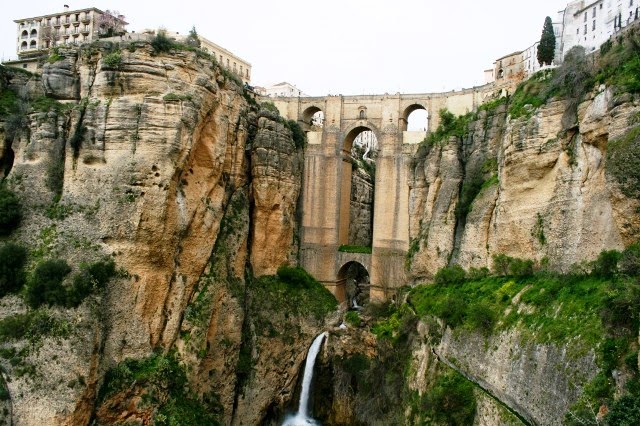
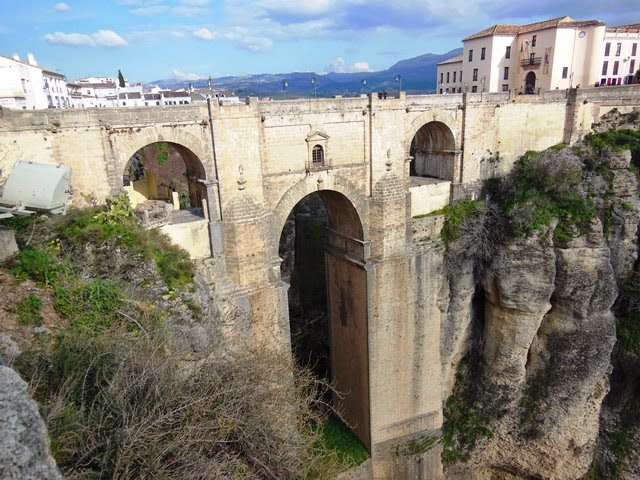
Puente Nuevo

Filling our 6 kg propane gas cylinder was not possible in Gibraltar and required a 45min trip up the coast to Estepona in Spain. While possible to catch a local bus, we decided to hire a car stopping at Estepona and then visiting Rhonda, about a 2hr drive from Gibraltar. Established in the 9th century Rhonda is one of the most ancient cities in Spain and is high in the mountains. Rhonda is spectacular location with a rich history, dating back to Islamic times with  the Moorish city walls and mosques still evident along with a Roman theatre carved out of rock.


The Puente Nuevo (New Bridge) is the "newest" bridge & largest of three bridges that span the 120mtr chasm of the Guadalevin River.The bridge was started in 1751 and took 42 years to build. The chamber above the central arch was used for a variety of purposes, including a prison.  Allegedly some prisoners were killed by being thrown from the windows during the Spanish Civil War.


We visited the bullring in Rhonda which is recognised as the first purpose built space for fighting bulls. At 66 meter diameter it is the largest, and most dangerous bullring with seating for 5,000.  After six years of building, the first bull fight occurred in 1758. The bull fighting museum provided an excellent history of bullfighting, the matadors and customs. We learned about the infamous Pedro Romero who retired from the art of bullfighting after killing 5,000 bulls without suffering any personal injury. 

Over the last few weeks we have been studying the weather forecasts in anticipation of departing. Over the next two months we need to get to Greece - basically heading east for roughly 2,000 NM. Below is last week's forecast, we are hoping we don't see too many like this in the next few months - gale force winds from the east for most of the Med.


Below are some photo's from Rhonda.


A missed calling possibly?


Sunday, 1 March 2015

Winter Lay Over

Oven Repairs = no cooking for 6 days
After almost three months in Gibraltar our winter task list is almost complete with Sabbaticus showing the results of the constant attention and many hours of labour.  How naive we were to think we could have managed paid employment during our winter stop over - surprisingly the boat tasks have been all consuming. 

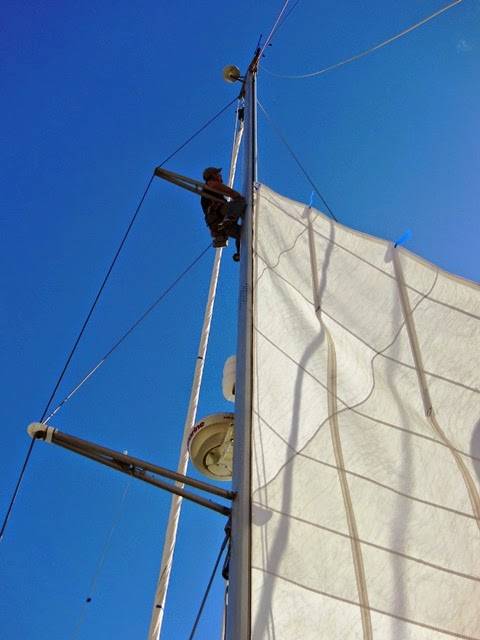
Attaching tell tales to the main

Our maintenance lists now shows 65 tasks completed, while satisfying there is always more to do which ensures there is never a dull day without activity.  The range of tasks have included; three coats of polish on the fibreglass, diving the boat to inspect and clean the hull, repairing the oven, sewing covers for the NAV plotter and outboard motor,installing a new winch control unit, oil changes, fitting the fishing rod holder, getting the sails re-cut and new shorter battens installed, servicing all (7) winch's and the windless (for the anchor), replacing the bow, gas and lazaret locker seals, cleaning the teak decks, restocking the boat, refueling the diesel, reading and planning the passage to Greece   .... the list just goes on so we will stop there!
 
Servicing the winch's
While none of these tasks are difficult it is surprising how much time is spent researching to find the right part number, sourcing the spares, talking with manufacturers on the repair process and then waiting for the spares to arrive.  We have sourced parts now from the UK, Canada and Sweden, ironically the UK parts always take the longest (up to 3 weeks) to arrive through the postal and subsequent customs process.  A simple task of collecting spares from the courier required four different office calls at the airport before the spares were released by customs.  Logistics can be so frustrating at times and is not assisted when the incorrect part is shipped and then everything shuts down for Christmas holidays resulting in another delay!  Thankfully the UK Oyster Customer Support provided by Sam has been invaluable at collating our spares order and sending one consignment avoiding more costs with customs clearance for each shipment. Lessons learned have showed us the advantage of being in one location for an extended period to access wifi, receive parts and re-stock spares used.


Anti-Chafe destroyed
Katabatic winds in the marina
Our winter has been very mild with only about 2 weeks total of wet weather which has made it easier to complete our 'outside jobs'.  We have experienced some katabatic winds, resulting in gusts up to 50kts in the marina, the wind indicator misaligned and corresponding surges for a few days. At time like this it would have been good to be living on land and not have the disturbed sleep hearing the constant noise, groans and movement of Sabbaticus as she strains on her mooring lines. Although we had spent considerable time researching and then procuring anti-chafe webbing from the UK - after three days of surge the anti-chafe was worn through which was disappointing.  

Refueling at Gibraltar was a pleasure with tax free diesel at .39p the tanks (total capacity of 770 litres) are now filled for our passage across the Med. We are now waiting for our last two spares to arrive so that we can start heading east to ensure we are in Greece by May to meet Maree and Colin (John's sister and brother-in-law) who are joining us for six weeks cruising the Greek Islands. 

Refueling in anticipation of leaving
 Time to start passage planning for our trip across the Med ........