Monday, 21 September 2015

Passage to Crete


Sally & Bata arrive 
Sailing friends from the UK, Sally and Bata, were keen to join us for the passage from Turkey to Sicily and joined Sabbaticus in Fethiye. After a couple of days acclimatizing to the warmer temps, enjoying swimming at anchor and a few local meals out we departed Fethiye for Crete. The weather forecast looked promising for a three day passage but as we continue to learn the the forecasts are changeable.

Lindos Acropolis
The first 5hrs was perfect weather but the wind steadily increased to 35kts. This was time to remove the reefed genoa and put up the storm jib. John had the task of going on the foredeck and rigging the forestay for the storm jib – with waves breaking over the bow it was hard wet work but at least the water was warm! After sailing in wind of Force 7/8 (28-40kts), and the inevitable seasickness, we decided to seek refuge on Rhodes Is and anchored in Lindos the next morning. This was a fast passage of 125NM with a max speed of 9kts and average of 6kts which was impressive given most of the trip was sailed under storm jib & a heavily reefed main sail.   

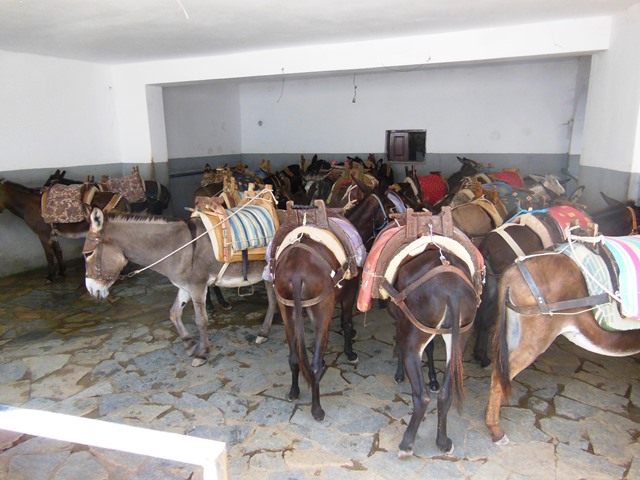
Waiting for customers
Downtime
With nobody keen to cook or eat any food during the previous 24hrs it was a quick breakfast and then to bed for several hours to recover.  After cleaning Sabbaticus to remove the salt residue, and John going up the mast for a minor sail repair, it was time to launch the dinghy to visit the imposing acropolis of Lindos perched on a sheer cliff face above the village. Lindos was first inhabited around 3rd century BC and is now a village comprising a maze of narrow lanes and whitewashed houses.  We enjoyed seeing the many donkeys around the narrow streets but not the large tourists riding the donkeys to the acropolis. 

The unexpected diversion to Rhodes meant we needed a Greek data plan for weather forecasting. This loggie task required Sally and Leanne to forego a relaxing day on the boat swimming/reading and catching a local bus into Rhodes to find the Vodafone shop. The data plan task was quickly achieved and we were then free to enjoy the sights of the Old Town of Rhodes. The Old Town is a medieval walled city contained within 4kms of walls surrounded by moats. Eleven gates access the Old Town with a mixture of different architectures from various historical periods dominated by the Order of St John and the Ottoman period. Approx 10,000 people live and work in the Old Town which was fascinating to wander around the medieval buildings, castles, narrow streets, houses, mosques, fountains and squares.  

A short swim home...


After arriving back in Lindos we saw John & Bata on Sabbaticus and waved frantically from the beach. Despite a pre-planned pick up point/time the dinghy never arrived so the only option was to swim to the boat. Leanne stripped down to her underwear and swam to the boat where John promptly departed in the dinghy to pick up Sally with all the groceries. After three days in Lindos the winds were favourable for the passage along the top of Crete. Of interest, Crete is the largest Greek Is and is known as the home of Europe’s earliest civilization. Crete has a strong agriculture economy and is probably one of the only Greek Islands that could support itself without tourism.

Sitia Town Quay

Our next unplanned stop was Sitia in Crete.  After leaving Lindos the first 8 hrs were relatively easy sailing until the wind increased to 30kts, resulting in the storm jib being raised at 2200hrs and the main sail reefed down further. After 36hrs sailing we decided to stop at Sitia town quay and arrived just on dusk after 200NM with a max speed of 10kts. Sitia is a small town unaffected by tourism and felt quite authentic with a pretty harbor, waterfront bars and cafes surrounded by the local fishing boats. A Venetian Castle dominated the hilltop and provided great views over the bay.  
 
Spinalonga

After two nights we then departed Sitia to Spinalonga Lagoon which was a lovely day sail across the bay. Spinalonga Lagoon is about 2NM long and provided excellent shelter from the weather and is named after Spinalonga Island which is at the entrance to the lagoon. We anchored in the bay and took the dinghy for a trip to Spinalonga Island. The island is a barren and rocky islet with a forbidding 16th century Venetian fortress that withstood Turkish invaders for 45 years after the mainland had fallen. From 1903-1957 the island was used as leper colony for Greece and the unfortunate inhabitants experienced the reality of living and dying in isolation. Although now deserted, the picturesque island of ruins has become synonymous with suffering and has an unnervingly sense of desolation.

Spinalonga - Venetian Fortress 

While visiting Spinalonga Island Leanne heard another kiwi accent and realized it was another NZ yachting couple we had met in Turkey. This resulted in Brigitta moving across to our anchorage and joining us for sundowners onboard Sabbaticus. The next morning the forecast looked favourable so we headed out of the lagoon only to return six hours later when the forecast changed dramatically with thunder, lighting and 45kts head winds. With no safe anchorages close by we motored back to Spingalonga. After squalls, rain (first time we have experienced rain since June), thunder and lightning the weather settled down and we had a good night’s sleep. We then departed Spinalonga the next morning (finally) for Khanai at the West end of Crete to preposition ourselves for our 500nm crossing to Sicily. 


Our 'neighbour' in Sitia town quay

Lindos tourist beach 
Lindos village
Lindos acropolis and amphitheater
Spinalonga Island

Thursday, 10 September 2015

Leaving Turkey


Marmaris Castle built 1044BC
Despite the plan to sail from Marmaris  to Goeck we were thwarted by lack of wind and ended up sailing around Marmaris bay and anchored outside Yacht Marina where we started from.  Marmaris Bay is the centre of Turkish yachting and charter industry and a beach holiday destination. The large bay is picturesque and is surrounded by pine forests and hotels with numerous anchorages. The town of Marmaris was devastated by an earthquake in 1958 so not many old buildings remain the exception being the medieval fortress built on a rocky knoll. The only positive of returning to the same place was a kiwi yacht was already anchored there which resulted in an enjoyable evening of drinks onboard Birgitta.
Daily exercise taking lines ashore
The next day the wind arrived and we had a great day’s sailing, in prefect conditions reaching in 15kts to Gocek 45NM. On arrival, we planned to anchor in 22 Fathom Bay (a deep by on the W coast of the bay).  However, this planned was thwarted by our inability to set the anchor in 15-20mtrs of water. Despite two different locations and the anchor being reset six times it would not hold in the weedy / muddy bottom.  By this time the windlass (anchor) switch had overheated and failed - along with our sense of humour.  With only one hour of light left we motored off in frustration to a Goeck marina for the night.  Goeck has five marina’s which appears to be the major industry with a lovely village to stroll in. The next morning we were relieved to have the windlass switch operating and headed out to find a bay to anchor in.

Friendly local visit
Finally on the mooring
As we were motoring past Adasi Island Leanne spied some mooring boys so we quickly diverted to pick one up. This became another trial and learning point - after picking up the the first bouy we realised by the time Sabbaticus swung around we were too close to shore. The next bouy we picked up was then too close to some rocks.  We rounded the next point and picked up another bouy - having secured one line ashore the second line was too short.  Arghh! Our sense of humour was starting to fail again - the fourth bouy was perfect. After all this effort we stayed fora couple of nights to rest and relax with lots of swims to cool off in the inevitable midday/afternoon heat. The bay is beautiful with pine covered slopes to the water edge, deep clear water, and large turtles swimming in close proximity to the boat. Every day we had new 'neighbours' arrive, usually tourist gulets stopping for an hour to swim before the next boat arrived so there was plenty of anchoring skills.

Memorial to Fethie Bay
It was then a short trip, 12NM, across to Fethiye located in another picturesque bay with pine trees around the natural harbour.  We anchored in the bay outside the marinas - all the better to get the cooling breeze.  Although Fethiye was flattened in the same earthquake as Marmaris the ancient theatre, medieval fort and Lycian rock tombs survived. The largest tomb is the Tomb of Amyntas, dating back to 4th century BC. We learned that Fethiye is named after a local Air Force aviator who died while attempting to fly between Istanbul and Cairo in 1914. 
 
Men's coffee group?
Wile we would have liked to head further south, there was no wind forecast and motoring for 8 hours was not appealing. So instead we had a relaxing few days at anchor with daily trips into Fethiye town where Leanne enjoyed the markets and John the wifi cafés. As always the local cafes had the men sitting around drinking coffee while board games - a familiar sight in Turkey and Greece. Rarely are groups of women seen sitting around - guess they are all at home working.
 
During the time in Fethiye Sabbaticus was re-provisioned, spares re-packed, laundry taken ashore for a 'real wash' as opposed to buckets on the foredeck and another boat wash completed in preparation for our passage to Sicily.  Friends from the UK, Sally and Bata, are joining us for the trip to Sicily which will be good to have the company onboard and longer sleeps during each watch change which will be luxury. After doing day sails for the last few months we are keen to get going and sail a longer passage - this will be the last passage for this season before Sabbaticus hibernate's in a marina in Sicily for winter. 

 
Lycian Rock Tombs - 4th century BC

Marmaris monument to Ataturk - Turkey's first President

Monday, 31 August 2015

On the Hard in Marmaris, Turkey

Finally hauled out - 6 hours late!
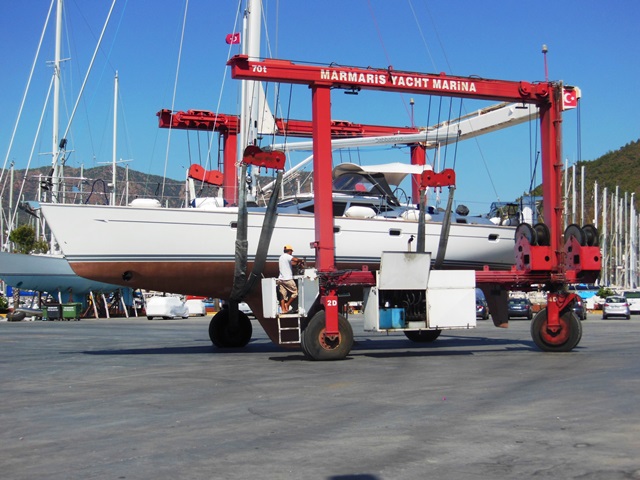
After discussing the options for sometime and receiving numerous quotes we decided to haul Sabbaticus out of the water in Yacht Marina, Marmaris to have the coppercoat re-applied to the hull (her bottom) and complete some other minor maintenance tasks. While we lose cruising time it was more cost effective to complete this job in Turkey as opposed to Sicily where we are booked into a marina for winter. After an early start we were at the marina waiting for the agreed 0900hrs haul out only to wait alongside in the heat until 1500hrs when we were finally lifted. We were not impressed as our contractor, Murad (from Port Yacht Technic) was patiently waiting to commence work with his team and we lost one of our contracted 15 hard standing days.

Support struts positioned
We were a bit apprehensive when we saw the support struts for Sabbaticus, 13 poles and wedges used to keep her secure. We felt a bit unstable on the first night - given this was our first time on dry land for 15 months it felt like Sabbaticus would topple over.  This was not helped by John stating if she goes over make sure you go for the high side and hang on! 

Having now experienced living on the hard we now understand why there is a special summer rate as it is incredibly hot and humid working in Aug. With no air conditioning, fridge or freezer (these only operate when we are in the water) and no toilets or shower facilities onboard (we trudge across the dusty yard to use the marina bathrooms and carry numerous buckets of water up and down the steps each day), it was trying times onboard and difficult to cook and sleep in the heat. Yet another good team building experience!

Yacht Marina
Two different worlds
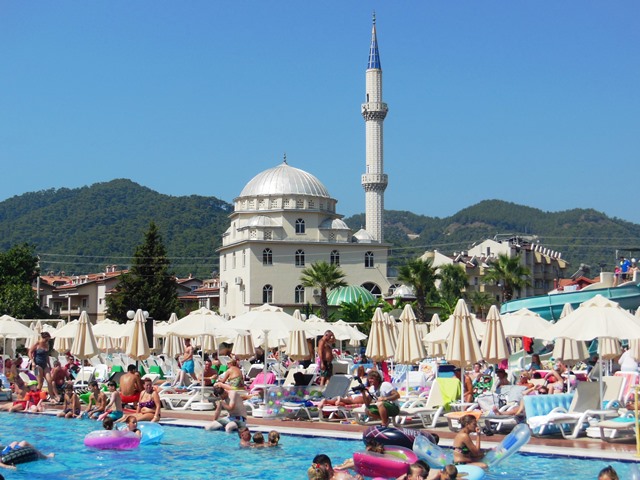
Despite the heat (most days 35 -38 degs) Yacht Marina was an easy place to stay with a large supermarket, air conditioned library, pool, free ferry to the city centre, hair dresser and fitness centre. The marina has 700 berths and hard standing for 1,000 yachts with a large chandlery and repair workshops on site so very easy to get work on the boat completed.  Due to the high temps we treated ourselves to one night in a hotel in town to enjoy the luxury of an air conditioned room.  Our one night off the boat gave us a glimpse into UK focused holiday resorts (Hi-de-Hi campers!), complete with a mosque visible from the pool. 

Engine trials
GRP spot repairs
After 15 days the maintenance task list was completed and we were back in the water.  Murad and his team did an excellent job of re-applying the copper coat which required careful planning and meticulous attention to detail in application given the extremely hot conditions.  They also did a range of other minor repairs including woodwork, engine maintenance (removal, cleaning and installation of the heat exchanger), varnishing and spot repairs to the GRP.  We were impressed with the quality of workmanship exhibited by Murad and his team.  One of the highlights of our time in Marmaris was dinner at Murad's apartment with his family where we learned his expertise extends to the kitchen with a delicious meal of spare ribs.


Rudder servicing

New anchor chain markings
Despite contracting some of the work out our days were still busy with routine maintenance including servicing the 23 thru hull fittings, replacing anodes, cleaning the prop, cleaning the bilges, cleaning the sails and minor repair work, painting the anchor chain intervals and the list goes on and on with a total of 52 tasks completed. This did not include a total clean of the boat inside and out when we were back in the water to remove all the dust from the yard which seemed to go everywhere. Plus, the numerous loggie runs into town for local purchases. 

One observation from being in the yard is older men walking, or biking, in their speedos!  If John ever thinks about this dress option then it is time to move back on land. We are now looking forward to another three weeks cruising down the coast of Turkey before starting the passage to Sicily.


Sabbaticus with her new coppercoat bottom
Moving back into the water

Yacht Marina


Sunday, 16 August 2015

Arriving in Turkey

From Kalymnos (Greece) it was a short 12NM sail to the entry port of Turgutreis in Turkey. In contrast to Greece's carbon copies, huge ledger books and manual processing for customs and port police Turkey's system is computerized and required an agent to be employed to process us into the system/country. After handing over Sabbaticus's documentation we returned two hours later, paid the Euro 185 had our passports stamped and were in possession of the mandatory Turkish transit log. Easy!

Anchored off Knidos ruins
We then departed the marina to the closest anchorage and were surprised to tune into a local radio station playing 80's music which we enjoyed during the short sail to Akaylar. This anchorage was in an attractive touristy bay and while a quiet spot during the day the night's entertainment started at 2200hrs with laser light shows and a loud band that played into the early hours. It was another night of ear plugs to ensure quieter sleep.

Castle of St Peter

The next day we sailed to Bodrum anchoring off the impressive Castle of St Peter where construction started in 1406 and finally finished in 1522.  With five towers built by five different nations the castle was an impressive sight. After a couple of days in Bodrum we had had enough of the maddening crowds of tourists, heat and the nightly noise of nightclubs. The beaches in town were packed and with murky water so it was a relief to return to Sabbaticus to swim off the boat in cleaner water and watch the numerous tourist Gulet's in the harbour. Gulet's are the traditional two-masted, or three-masted, wooden sailing boats built around Bodrum or Marmaris and are now used primarily for tourist charters of which they are plenty.

We then spent several weeks enjoying sailing each day to different anchorages and seeing pine forests, clear beautiful water and peaceful anchorages. The sailing has been perfect with the breeze coming in each day about 1400hrs and lasting for 3-4 hours giving us enough time to move anchorage. Some of the highlights were  anchoring in English Harbour, which the Special Boat Squadron used as a base during WWII; anchoring in Knidos outside the ancient ruins, Cokertme, and Gerbsake where we climbed the hill to an impressive ancient citadel along the ridge line.

We are now getting quite used to med mooring anchorages which are used when anchoring in small coves and in deep water which is common in Turkey.  We drop our bow anchor (usually in deep water) and then reverse close (10-20m) into the shore (sometimes squeezing ourselves in between adjacent boats), John then swims ashore with two stern lines and secures them to trees or rocks on the shore.  This holds the boat in close proximity to the shore and also effectively negates the boat swinging at anchor (often there is no room to 'swing'). In one bay we found a perfect cove where a local fisherman was repairing his lines for the day. He waved us in gesticulating where we could take lines ashore which was generous given we were practically on top of him. Feeling a tad guilty John swam over with a cold can of beer which seemed to appreciated.

Wasps to be avoided
While the anchorages have been  picturesque some of them suffer from a dusk invasion of wasps which is annoying and painful as John found out. The wasps appear to be attracted to water and hang around the swim platform which makes for a fast exit when getting back onto the boat to avoid being stung.  We made the mistake of leaving a bucket of washing out one night which was covered in wasps the next morning. Another mistake was leaving the swim ladder unlocked so when Leanne emptied the morning coffee granules overboard and held the swim ladder she fell into the water. Other than feeling like an idiot there was no harm done it was just another warm swim for the day. John failed to notice my unplanned departure which is a worry!

Bliss...
Our days now start and end with a swim, with many swims in between. The weather is just too hot to move quickly and even the water (tepid) is no longer refreshing. We have now become quite efficient at erecting the sun shade which is the first task at each new anchorage to keep the sun off the decks and the boat cooler. While teak decks might look good we are no longer fans of them - the decks are now  too hot to walk on with bare feet and any spillage requires immediate spot cleaning. Despite a desire to 'follow the sun' and avoid winters we find we are now longing for cooler temps under 30 degs.  Our next port of call is Marmaris where Sabbaticus will be hauled out of the water for some TLC.


Below are some photo's from the different anchorages.
  
View from the citadel at Gerbsake
Anchored alongside a Gulet in Bodrum
Crowded pebble beaches - not our idea of a holiday
Sabbaticus (closet white boat) anchored with lines ashore in Gerbsake
John in the bushes finding a tree for the mooring line